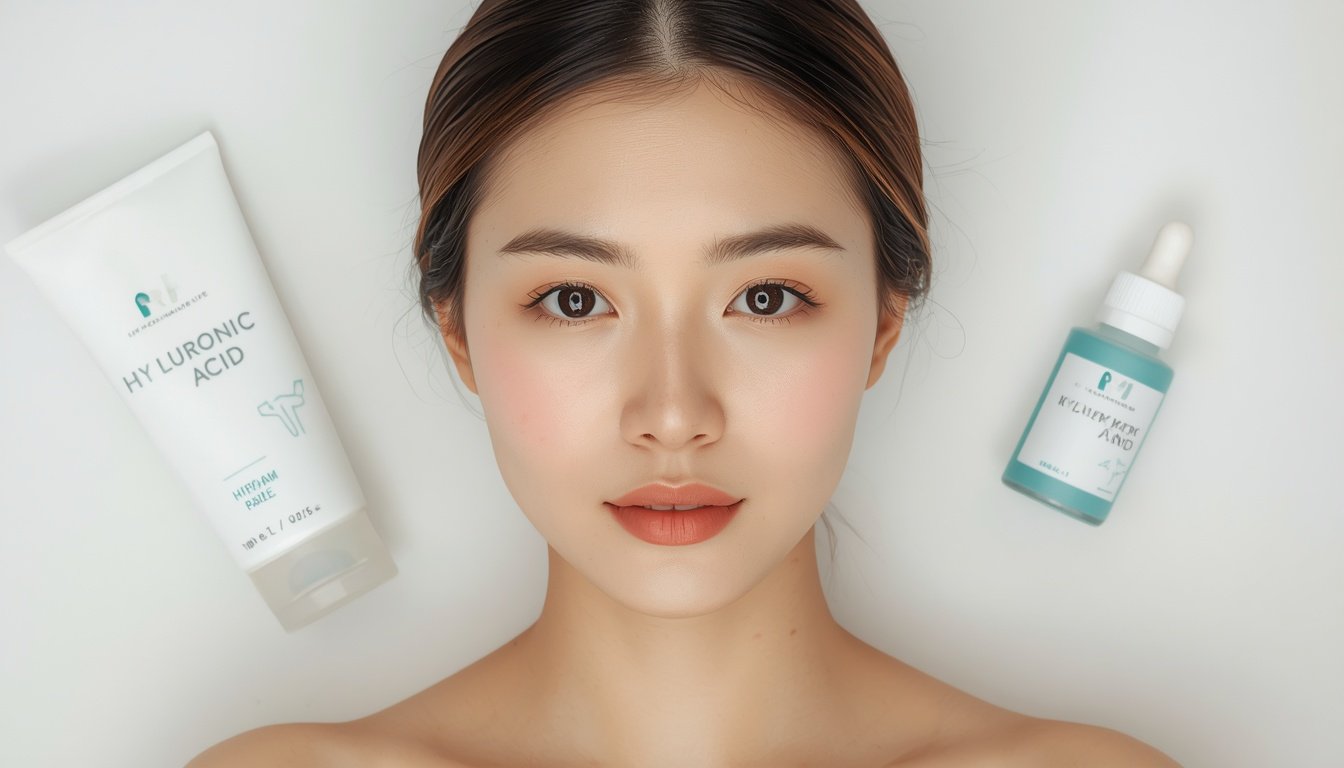
What Is Hyaluronic Acid?
Hyaluronic acid (HA) is a polysaccharide — a long-chain sugar molecule — produced naturally by your body. It is found in the highest concentrations in the skin, eyes, and joints, where it acts as a cushioning and lubrication agent. In the skin specifically, HA is the primary molecule responsible for moisture retention: healthy young skin contains approximately 50% of the body’s total HA content.
As we age, HA production declines — contributing to the loss of plumpness and elasticity that characterises ageing skin. In Korean skincare, topical HA application became a cornerstone of hydration philosophy in the 2000s, and Korean formulators were among the first to isolate and test different molecular weights for different skin depths.
The HA used in skincare is synthesised via bacterial fermentation (typically using Streptococcus equi bacteria in a controlled laboratory environment) rather than derived from animal sources. It is vegan-compatible and one of the most broadly tolerated skincare ingredients across all skin types.
The Molecular Weight Problem — Why Not All HA Is Equal
This is the single most important thing to understand about hyaluronic acid in skincare — and the thing most product descriptions and beauty editors get wrong or ignore entirely.
HA is not one molecule. It exists across a spectrum of molecular weights, measured in Daltons (Da), and each molecular weight behaves differently on and in the skin:
High molecular weight HA (1,000–1,800 kDa) — the largest form. Cannot penetrate the skin barrier at all. Sits on the surface of the skin, drawing moisture from the environment and creating a film that temporarily plumps the appearance of fine lines. Good for immediate visible results. In Korean skincare this is often labelled Sodium Hyaluronate at standard synthesis weight.
Low molecular weight HA (10–100 kDa) — penetrates the outer layers of the skin and delivers hydration to the viable epidermis. Takes longer to show visible effect but produces more sustained hydration. Often labelled Hydrolyzed Hyaluronic Acid or Sodium Hyaluronate Crosspolymer.
Ultra-low molecular weight HA (below 10 kDa) — the smallest form. Penetrates deepest and produces the most biological interaction with skin cells. Some studies suggest anti-inflammatory activity at this size. Often proprietary — Torriden’s Dive-In Serum specifically markets its low molecular weight formulation.
What Hyaluronic Acid Does for Skin
Surface hydration. High-MW HA draws moisture from the environment, creating an immediate plumping effect visible within minutes of application. This is the “before and after” mechanism behind most HA demonstrations.
Deep hydration. Low-MW HA penetrates the epidermis and delivers hydration to the living skin cells beneath the surface layer. This is slower to show visually but produces the sustained plumpness and bounce that distinguishes well-hydrated skin from dehydrated skin.
Wound healing support. Ultra-low-MW HA has demonstrated pro-healing activity in wound repair studies — accelerating keratinocyte migration and reducing inflammation at the injury site. This explains why HA features in post-procedure and acne-recovery skincare.
Barrier support. HA in the skin matrix supports the overall structural integrity of the skin. Chronically dehydrated skin has measurably impaired barrier function compared to adequately hydrated skin — HA restoration is part of barrier restoration.
The UK Humidity Problem — Why HA Can Backfire
This is the most important section in this article for UK readers, and the reason why some people report HA “not working” or making their skin feel drier.
Hyaluronic acid is a humectant — it draws water molecules toward itself. On the skin surface, high-MW HA draws moisture from the surrounding environment into the skin. In conditions of adequate humidity (50–70%), this works exactly as intended.
In conditions of very low humidity — below 30–40% — the mechanism partially reverses. With insufficient atmospheric moisture to draw from, high-MW HA begins drawing moisture from the deeper layers of the skin toward the drier surface, where it evaporates. Net result: increased transepidermal water loss (TEWL) and skin that feels drier than before HA application.
Who Should Use Hyaluronic Acid
Dehydrated skin — the primary indication. Note that dehydrated skin is different from dry skin: dehydration is a lack of water in the skin regardless of oil content. Oily skin can be severely dehydrated; dry skin is characterised by insufficient oil production. HA addresses the water component specifically.
All skin types benefit from HA when used correctly. Oily skin benefits from the lightweight hydration HA provides without adding oil. Dry skin benefits from the surface and deep hydration. Sensitive and acne-prone skin tolerates HA well — it is one of the least irritating active ingredients available.
Ageing skin — HA depletion is a measurable component of skin ageing. Topical HA cannot fully replace the structural HA decline that occurs internally, but it measurably improves the appearance of fine lines and skin texture with consistent use.
How to Use Hyaluronic Acid Correctly in a Korean Routine
Step 1: Cleanse and tone as normal.
Step 2: While skin is still damp from toner (or mist your face with water if your toner has fully absorbed), apply your HA serum. Two to three drops for the face. Press into skin with clean hands — do not rub.
Step 3: Apply moisturiser within 30 seconds of the HA serum. In UK winter, this is non-negotiable. The moisturiser creates the occlusive layer that seals the HA and prevents reverse moisture migration in low-humidity conditions.
Do not: Apply HA to completely dry skin in winter. Do not let HA serum dry on the skin surface before applying moisturiser. Do not skip the sealing step and expect HA to work effectively in a centrally-heated UK home between October and March.
Best Hyaluronic Acid Products Available in the UK
Above links are Amazon UK affiliate links. Full disclosure policy.
Reading Hyaluronic Acid on Ingredient Labels
- Sodium Hyaluronate — the salt form of HA. Most commonly used in skincare. Slightly smaller than pure hyaluronic acid and penetrates marginally better. When listed without molecular weight specification, typically high-MW (surface hydration only).
- Hyaluronic Acid — the acid form. Less stable than sodium hyaluronate but functions similarly. Usually high molecular weight.
- Hydrolyzed Hyaluronic Acid — enzymatically broken down into smaller fragments. Low to ultra-low molecular weight. Penetrates deeper than standard sodium hyaluronate.
- Sodium Hyaluronate Crosspolymer — chemically modified to form a mesh-like structure on the skin surface. Long-lasting surface hydration. High-tech surface treatment rather than penetration-focused.
- Sodium Acetylated Hyaluronate — acetylated form that is more water-repellent and therefore stays on the skin surface longer. Provides extended surface hydration beyond standard high-MW HA.
Frequently Asked Questions
Want a routine built for your skin?
Take our free 2-minute skin quiz for a personalised Korean routine including the right HA products layered correctly for UK climate conditions.
Take the Free Quiz →